Getting injured can leave you wondering when you can safely return to training, competition, or even normal exercise. Your first sports therapy session is designed to answer those questions by identifying what is limiting your movement and creating a structured plan for recovery.
At TheraCave in Fort Lauderdale, sports injury rehabilitation is built around the individual athlete rather than a generic treatment protocol. Licensed physical therapists for sports therapy to evaluate the injury, assess movement faults, consider the demands of your sport, and develop a rehabilitation plan based on your recovery and return-to-play goals.
Whether you are recovering from an ACL injury, rotator cuff problem, plantar fasciitis, meniscus tear, tennis elbow, Achilles injury, or another sports-related condition, the first appointment establishes the foundation for the rest of your rehabilitation.
Step 1: Discussing Your Injury and Goals
Your first session begins with understanding what happened and what you want to accomplish.
Your therapist for sports therapy may discuss:
- How and when the injury occurred
- What movements cause pain
- Changes in strength or mobility
- Previous injuries or surgeries
- Your current activity level
- The sport or activities you want to return to
- Your personal recovery goals
This conversation matters because sports therapy is not simply about making pain disappear. The goal is to understand how the injury affects your ability to move and perform.
For an athlete, returning to everyday activities may be only the first milestone. Returning to sprinting, jumping, cutting, throwing, lifting, or competing may require substantially more rehabilitation.
Step 2: A Comprehensive Physical Evaluation
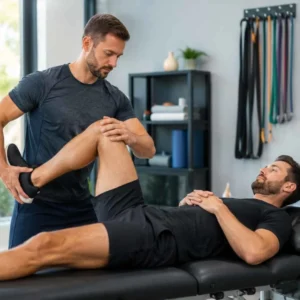
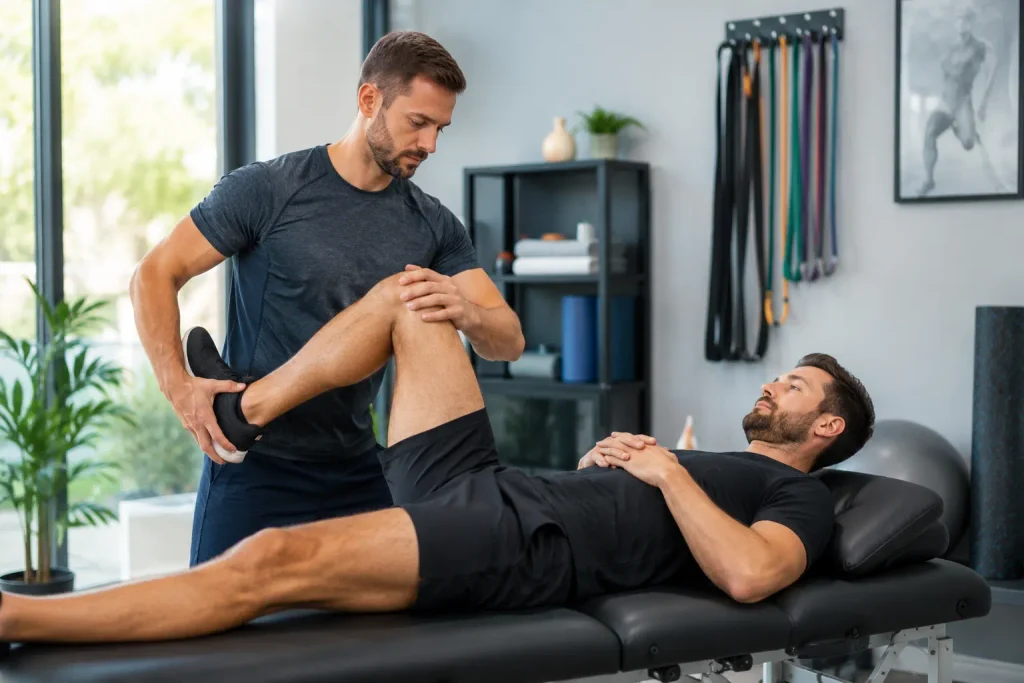
After discussing your symptoms and goals, your licensed physical therapist for sports therapy performs a detailed physical assessment.
TheraCave’s sports injury rehabilitation process includes hands-on testing and movement screening to identify the injury, potential contributing factors, and movement faults. MSK ultrasound imaging may also be used as part of the evaluation when appropriate.
What Does Movement Testing Look For?
Your therapist may assess areas such as:
- Joint mobility
- Muscle strength
- Balance and stability
- Range of motion
- Movement coordination
- Neuromuscular control
- Sport-related movement limitations
The purpose is to look beyond the location of your pain.
For example, an athlete experiencing knee discomfort may also have weakness, instability, or movement mechanics that contribute to the problem. Identifying those factors can help create a more complete rehabilitation strategy.
Step 3: Understanding What’s Causing the Problem
One of the biggest advantages of professional sports therapy is that treatment does not have to stop at the painful area.
Sports injuries can be associated with muscle imbalances, poor movement mechanics, overuse, weakness, instability, or returning to activity too quickly. TheraCave’s approach specifically emphasizes identifying the root cause and contributing movement faults.
Why This Matters for Athletes
Simply resting until pain improves does not necessarily restore the strength, stability, coordination, or confidence required for sports.
An athlete may feel better but still lack the physical capacity needed for cutting, landing, accelerating, decelerating, or repetitive sport-specific movements.
That is why an effective rehabilitation program needs to evaluate how your body currently performs, not just where it hurts.
Step 4: Receiving a Personalized Treatment Plan
Once the evaluation is complete, your therapist can explain the findings and develop an individualized plan.
At TheraCave, rehabilitation follows a structured progression that moves from evaluation and pain management toward strength, stability, mobility, and ultimately sport-specific return to play.
Your treatment plan may include different approaches depending on the injury and your individual needs.
Pain Management and Tissue Recovery
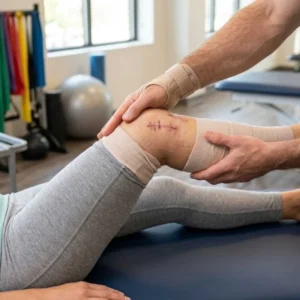
Early rehabilitation may incorporate techniques such as manual therapy, dry needling, shockwave therapy, or kinesiology taping when appropriate. These approaches are used as part of a broader rehabilitation strategy rather than as a replacement for progressive exercise.
Strength and Stability
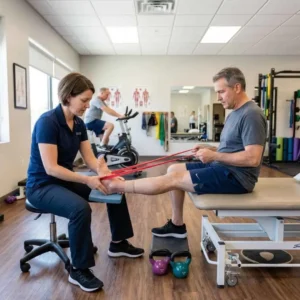
As recovery progresses, therapeutic exercises can help rebuild strength, joint stability, and neuromuscular control that may have declined after an injury.
Progressive loading is particularly important for athletes because returning to sport requires more than simply being pain-free.
Sport-Specific Training
Eventually, rehabilitation moves toward the specific demands of your activity.
Depending on the sport, that could involve agility, power, balance, running mechanics, jumping, throwing, lifting, or other movement patterns.
TheraCave’s return-to-play approach uses sport-specific drills and performance benchmarks rather than relying solely on the amount of time that has passed since the injury.
Why Professional Sports Therapy Is Important
Trying to determine your own recovery timeline can be risky. Pain levels do not always tell the complete story, and feeling better does not automatically mean an injured body part is ready for competition.
A licensed physical therapist can evaluate movement, strength, stability, and function using clinical assessment rather than relying only on symptoms.
Professional Assessment Reduces Guesswork
Instead of asking whether you are “ready” based on how you feel, sports therapy provides measurable information that can guide progression.
Rehabilitation Can Address More Than Pain
An effective program can work on the underlying deficits that may contribute to recurring injury, including weakness, poor mechanics, instability, and inadequate sport-specific conditioning.
Return-to-Play Should Be Individualized
A teammate may return from a similar injury at a different pace. Your injury, fitness level, sport, goals, and response to treatment all influence the appropriate progression.
What Should You Bring to Your First Session?
To make your appointment more productive, come prepared to explain your injury and current limitations.
If available, bring relevant medical records, imaging reports, surgical information, or other documentation related to the injury.
It can also help to wear comfortable clothing that allows your therapist to evaluate the affected body area and observe movement.
Most importantly, be prepared to explain what you want to get back to doing. Whether your goal is returning to recreational running or competitive sports, that information helps shape the rehabilitation process.
FAQs About Your First Sports Therapy Session
Is the first sports therapy session only an evaluation?
The first session centers on evaluation and developing an individualized plan. Depending on your condition and assessment, treatment may also begin as appropriate.
Do I need to be a professional athlete?
No. Sports rehabilitation can benefit competitive athletes, recreational athletes, weekend runners, and active individuals. TheraCave specifically states that its sports rehab services are designed for athletes and active people at different experience levels.
How long will sports therapy take?
Recovery time varies significantly by injury and individual circumstances. TheraCave notes that minor sprains may resolve in several weeks, while rehabilitation after procedures such as ACL reconstruction can take many months. Your therapist can establish milestones based on your specific condition.
When can I return to my sport?
There is no universal timeline. Return to play should depend on recovery, strength, stability, movement quality, and sport-specific performance rather than simply waiting a certain number of weeks. TheraCave uses performance benchmarks as part of its return-to-play progression.
Start Your Sports Therapy Journey With a Professional Evaluation
Your first sports therapy session is about much more than identifying where you hurt. It is an opportunity to understand how the injury affects your movement, identify contributing factors, establish realistic goals, and build a structured path toward returning to the activities you enjoy.
TheraCave provides 1-on-1 care with licensed DPTs and uses sport-specific rehabilitation, movement assessment, progressive exercise, and advanced treatment options when appropriate. Its approach is designed to help athletes progress from initial evaluation through strength and stability restoration and, ultimately, sport-specific return to play.
If an injury is keeping you from training or competing, contact TheraCave at (954) 284-0716 to schedule an evaluation and begin a personalized sports rehabilitation plan.